On the refit
Health & safety
on every programme.
A refit puts yard workers, specialist trades, crew and visitors on one vessel. We write the method down, brief the people doing the work, and keep the controls in place until the yacht leaves.
How we work
A written method before the tools come out.
Before work starts we write a risk assessment and a method statement for the job. The method statement is the order of work. The risk assessment names the hazard, who could be hurt, and the control. Spray work, solvent work and work at height are not given to anyone under 18, or to anyone who is pregnant.
Yacht Refit Asia holds a chemical and paint-use licence for the paints and solvents used on the work. The same practical controls are used in Singapore, Thailand and Vietnam. Each yard adds its own rules and its own permits. Work in Vietnam is carried out under the contract of Yacht Refit Asia Co., Ltd. (Thailand).
On site
The controls we use on the job.
Risk assessments and method statements
The method statement is the order of work. The risk assessment sits beside it: the step, the hazard, who could be hurt, the control, and the person responsible. It covers solvents and spray, fire, ventilation, heat, work at height, falling objects, enclosed spaces, temporary power, noise, dust, lifting, slips, and other trades on the same vessel. The people doing the job are briefed on it before they start. If the product, the place or the scope changes, the method is reviewed.
Toolbox talks
Supervisors hold a toolbox talk before the day's work starts. It covers that day's task, the hazards, the permit, the area other people must stay out of, and who to call if something is wrong. The talk is given in a language the person understands.
PPE
Protective equipment is matched to the task and put on before the work starts. A two-pack topcoat, including Awlgrip, Awlcraft 3000 and Alexseal, is sprayed in an air-fed hood or a powered respirator, with coveralls and nitrile gloves. Sanding uses dust extraction and a dust mask. Filler is handled in nitrile gloves, not latex, with the arms covered. Skin is washed with soap and water, not with solvent. A rash is reported straight away, and that person comes off the filler work. A tight-fitting mask is worn on a clean-shaven face.
Ventilation
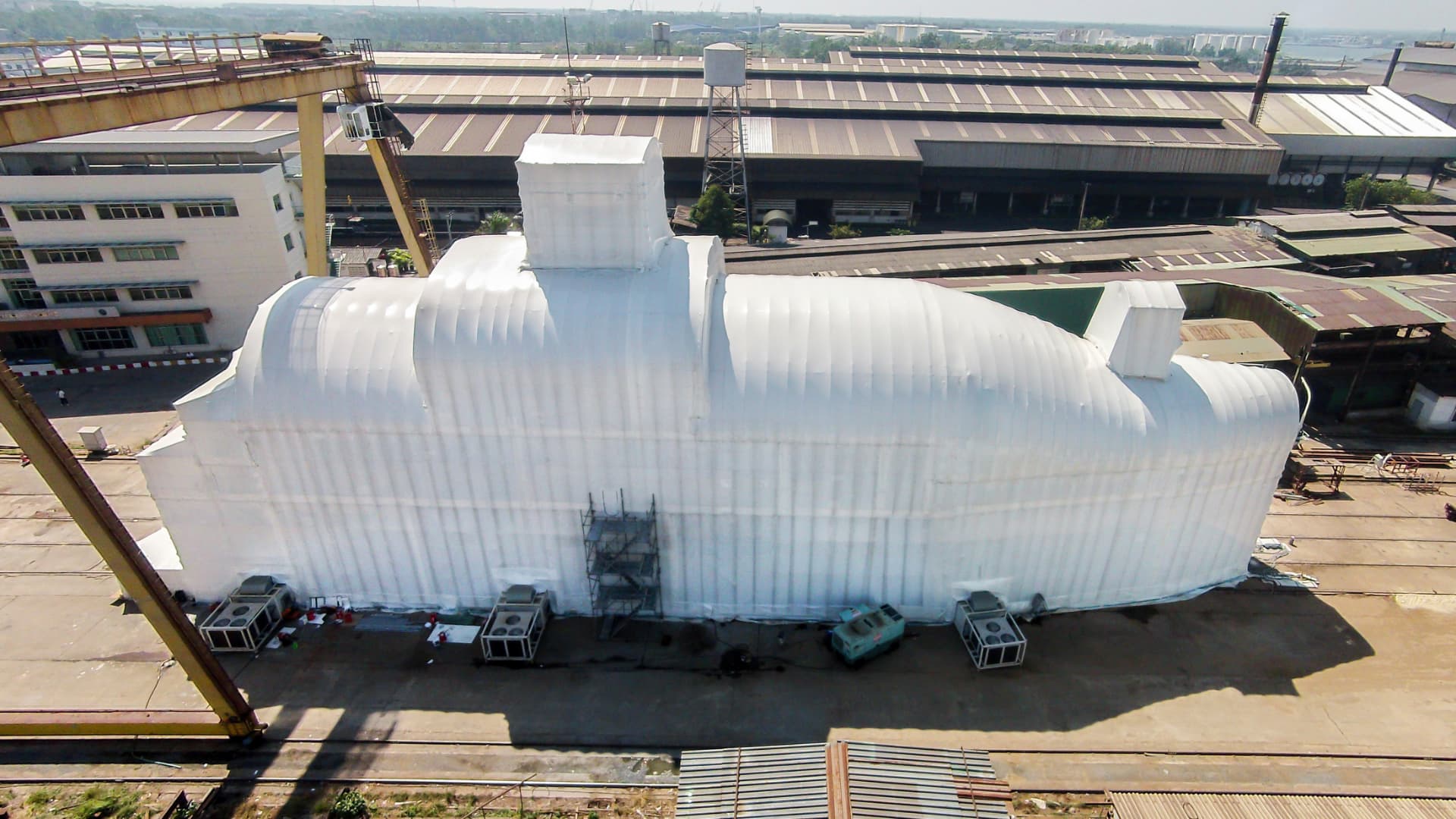
A tent or a shed is set up so air moves through it before anyone sprays. Extraction stays on while the coating goes on and while it flashes off. Lights and fans in the spray area are the kind that do not ignite vapour. Other trades stay outside that area while spraying is under way. The tent also keeps dust, overspray and wash-water on the job.
Chemical handling
Each product keeps its label, and the manufacturer's safety data sheet stays with it. Paint poured into another tin is labelled again. Mixing is done at a ventilated bench, with a tray under the tins and a spill kit to hand. At the end of the job, leftover paint, thinners and used rags are kept apart and returned to the store or placed in the waste the yard collects.
Permits, fire and hot work
A hazardous task starts when the permit is in place and on display, and the permit is closed when the task ends. Welding, grinding and cutting stay away from coatings, fuel and solvent stores. There is no hot work in the spray area while paint is going on or curing. Extinguishers are in place, smoking stays out, and the exits are marked. The crew knows the assembly point before the day starts.
Height and enclosed spaces
Staging and scaffolds are looked over before anyone climbs. Edges are protected, and anything that could fall is secured before people work overhead. Tanks, voids, bilges and lockers stay out of the job unless the air has been tested, someone is standing by, and there is a way to get a person out. Nobody goes in alone.
The yard and other trades
Each yard has its own rules. We take those rules before we mobilise, work to the yard's permits, and give the yard our method statement. Subcontractors are briefed on the vessel, the muster point and who they report to before they go aboard.
Reporting
What the owner and the captain hear.
- A toolbox talk at the start of each working day.
- An injury, a fire, a leak or a near miss is told to the captain and the yard the same day, and the action taken is written down.
- Safety notes from the programme go into the owner's progress reports.
- Permit notes are available to the owner's team on request.
Related: refit services · discuss a refit
Planning a refit?
Tell us about the vessel, the scope and the timing. Our team will review your enquiry and respond with a considered proposal.
Talk to our team